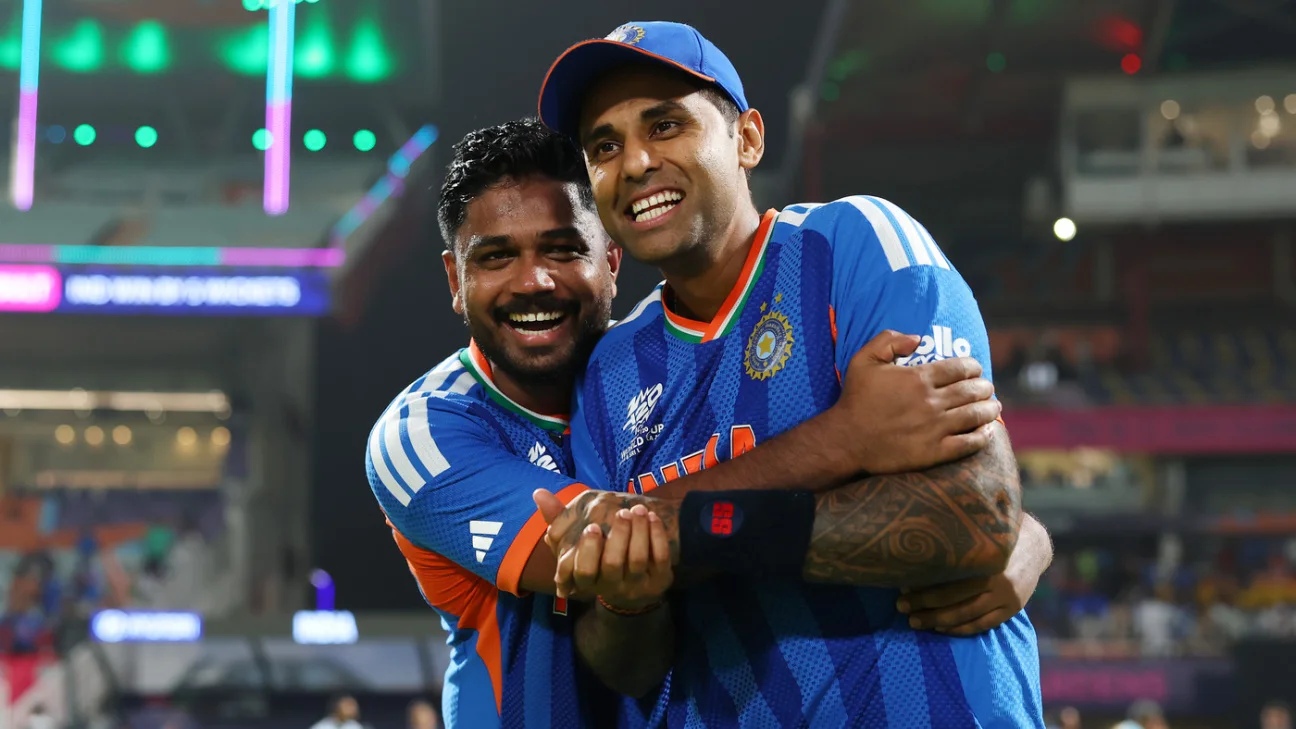
Big picture: Familiar foes meet again at penultimate hurdle
In whose camp would you rather be, ahead of a seismic semi-final that – to judge by its last two stagings in 2022 and 2024 – could yet prove to be a kingmaking contest? Would you rather be Team India, the defending champions and overwhelming pre-tournament favourites, riding a tide of expectation on home soil and now two victories away from becoming the first three-time winners in the history of the T20 World Cup?
Or would you rather be in England’s shoes … compilers of the scratchiest campaign imaginable, including flirtations with group-stage humiliation against both Nepal and Italy, but now back in the final four for a remarkable fifth tournament in a row?
As Will Jacks, England’s designated Plan B, acknowledged after another dicey win over New Zealand on Friday, in a perfect team performance, he would neither have to bat nor bowl. Instead, he has fronted up as their Player of the Match in a record-equalling four games out of seven so far.
And yet, as Jacks also acknowledged, who really cares about “perfect games” anyway? Neither of these teams has been at their best just yet, and in fact India have come the closest to touching the void: they were playing catch-up throughout the Super Eight after their emphatic loss to South Africa in Ahmedabad, and only secured their semi-final berth with a nervy win over West Indies in Kolkata.
But such is the nature of T20 cricket, those struggles have also been the secret to both teams’ successes. Instead of relying on familiar patterns to secure stress-free progressions, which in turn could have left them underprepared for this sharp end of the campaign, India and England have both had to dig deeper and access matchwinning performances from less heralded members of their squad.
Most recently it was the turn of India’s Sanju Samson. He owed his second chance to Rinku Singh’s family bereavement, but responded with 97 not out from 50 balls at Eden Gardens, which was more runs than he’d managed in his previous seven innings of the year combined.
England’s own depth has been accessed in a similarly roundabout manner. Twelve months ago, Sam Curran’s face didn’t fit, even though he’d been Player of the Match and Tournament during their last trophy-winning campaign in 2022. Now, as much through the shortcomings of others as through his relentless impact on the global T20 circuit, he’s been restored as their utility allrounder, and their go-to death bowler in times of high stress.
Likewise, Harry Brook’s promotion to No. 3 – a triumph against Pakistan – stemmed from perhaps the most glaring systems failure in England’s ranks. Jos Buttler and Phil Salt came into this tournament as the most imposing opening partnership on the T20 circuit. They’ve since managed a total of 84 runs in seven opening stands, none of which have extended beyond the fourth over. Buttler’s game in particular seems beset by an existential crisis.
On the one hand, it’s a handy problem to have – if the only way is up, then any reversion to type from hereon in is a bonus. On the other hand, it’s a weakness that invites India to lean into their most obvious pre-match advantage: an in-form and superbly varied bowling attack that should have the capacity to stretch England in directions they’ve not yet been taken.
Jasprit Bumrah, inevitably, is front and centre of India’s threat – though as a roving wrecker of ambition whose deployment can be tailored to his team’s precise needs, as he showed against West Indies with two innings-turning wickets in the 12th over of their innings. That differs markedly from England’s use of Jofra Archer, who has frontloaded with three powerplay overs for five matches running, as if clearing the decks for their mid-innings diet of spin. Archer’s contrasting head-to-heads with India’s openers suggests that Brook may be forced to think on his feet in this contest, to a greater extent that has had to in previous outings.
It’s hard to say just yet what victory or defeat will do for either team – but if their recent semi-finals are anything to go by, this promises to be another referendum for the loser. If “perfect games” are the goal, then – as Curran noted – England served theirs up in 2022: an extraordinary ten-wicket victory in Adelaide, in which Buttler and Alex Hales rampaged to their 169-run target with four overs to spare.
That triumph propelled England to their second T20 title, while also exposing the deferential nature of an India batting line-up that still counted its runs by volume rather than velocity. Two years later, the inverse was true. India’s crushing win in Guyana was no less emphatic, and confirmed the end of the road had been reached for England’s then-coach, Matthew Mott. With the Ashes in the rear-view mirror, it’s been a while since the B-word has been mentioned, but a similarly abject exit could well have similar implications for the Baz McCullum era.
Form guide
India: WWLWW (last five completed T20Is, most recent first)
England: WWWWW
In the spotlight: Abhishek Sharma and Jos Buttler
When Abhishek Sharma last faced England at the Wankhede, in February 2025, he unleashed on them such a dazzling display of strokeplay, it felt as though the parameters of T20 batting had been irrevocably shifted. With seven fours and a stunning 13 sixes, he laid waste to England’s pace-first plans and was scarcely less savage on England’s trump card, Adil Rashid, who finally induced a miscue on 135 from 54 balls, but not before he’d been savaged for 41 runs in three overs (coincidentally, one better than the analysis that Nepal inflicted on him at this same venue last month).
Times have changed rather quickly in the interim, however. The high stakes of a semi-final demand bravery from the outset, but Abhishek may need to mainline the good vibes from that contest if he’s to attack this latest one with anything like the same gusto. His campaign began with three consecutive ducks against USA, Pakistan and Netherlands, and though he found some welcome fluency in his 26-ball half-century against Zimbabwe, his 11-ball 10 against West Indies was an uncomfortable reversion to type. On balance, however, he’s arguably in a far happier frame of mind than England’s own problem opener…
Jos Buttler’s campaign is in full-blown crisis, but such is his stock and status within this dressing-room, it’s inconceivable that England will withdraw him from the firing line in favour of Ben Duckett or even Rehan Ahmed. And so, it comes down this (semi-)final roll of the dice. Can England’s greatest white-ball batter rediscover his mojo when it most matters, and if he doesn’t, can the rest of their players rally round to fill the breach, as they have done pretty admirably for most of this tournament?
Form in T20 cricket can be hard to quantify. Sometimes you just get out cheaply, and all you can do is shrug your shoulders – as Abhishek no doubt has been encouraged to do in recent weeks. Buttler’s issues, however, have been rather deeper-seated. He hasn’t scored so much as a boundary in five consecutive innings, all the while showcasing a grim lack of footwork that has often prevented him from laying bat on ball in his 15 runs across 27 balls. The good news is his campaign started with relative fluency at the Wankhede against Nepal and West Indies. The bad news is that he still only made 26 and 21 in those games, before twice falling at precisely the moment that the Buttler of old would have stepped onto the offensive.
Team news: Overton in for Rehan
Fitness permitting, India are unlikely to make any changes from the line-up that secured their progression in that de facto quarter-final against West Indies.
India (probable): 1 Abhishek Sharma, 2 Sanju Samson (wk), 3 Ishan Kishan, 4 Tilak Varma, 5 Suryakumar Yadav (capt), 6 Hardik Pandya, 7 Shivam Dube, 8 Axar Patel, 9 Arshdeep Singh, 10 Jasprit Bumrah, 11 Varun Chakravarthy.
Rehan Ahmed’s heroics against New Zealand were the promise of a rich future, but not so much of an indication of England’s present. He is all but guaranteed to make way for Jamie Overton’s heavier artillery, in a reversion to the go-to line-up that England have opted for almost throughout the campaign. Despite Buttler’s struggles, England will not be giving up on their white-ball GOAT just yet.
England (probable): 1 Phil Salt, 2 Jos Buttler (wk), 3 Harry Brook (capt), 4 Jacob Bethell, 5 Tom Banton, 6 Sam Curran, 7 Will Jacks, 8 Jamie Overton, 9 Liam Dawson, 10 Jofra Archer, 11 Adil Rashid.
Pitch and conditions
Pitch 7 has been allocated for this contest, centre of the square with equidistant boundaries on both sides. It is the same surface that was used for England’s group-stage defeat to West Indies, as well as Nepal’s shock loss to Italy, but it’s effectively a fresh surface after no useage since February 12. There’s a decent grass covering, which is likely to remain given the recent hot weather in Mumbai, and given the firepower on both sides, 200-plus totals seem preordained. Good bounce is anticipated, though maybe less turn than was on offer when Adil Rashid claimed 2 for 16 in his four overs against West Indies.
Stats and trivia
Quotes
“The way we’ve got here has given us a lot of confidence. We’ve won them tight games, which in World Cups prove to be very important. We’ve got a lot of confidence going into the deeper part of the games. We’ve won games that we probably shouldn’t have won. It just feels like we’ve never really been out of any games so far, which holds you in good stead in these world competitions.”
England’s captain, Harry Brook, believes the journey has informed the destination for his team.
“Here at Wankhede there’s always that extra bit of bounce. Guys can trust the bounce and hit through the line. But that can also, as a bowler, bring you into the game. The margins here is a lot smaller, the ball travels. It’s quite a small ground. You just need to be really fighting that over, stay in the moment and compete every ball. A batter’s strength can also be his weakness on the surface. So it’s sometimes not to go too defensive and keep on attacking, because opportunities can come.”
Morne Morkel, India’s bowling coach, on the challenge that awaits in Mumbai.